Learn to code with using Tynker

Taught
Enrolled
04759
Course
Lesson 1
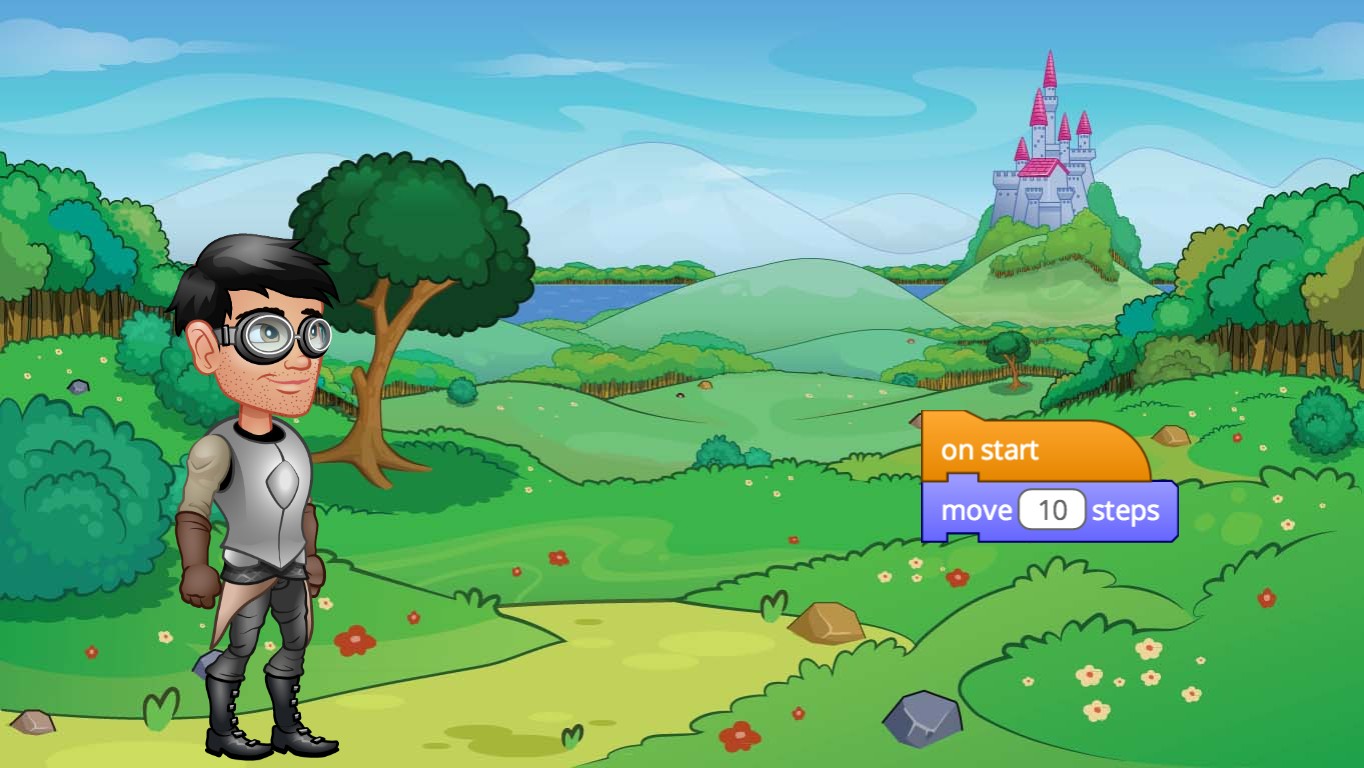
Welcome to Game Design
Get Introduced to Tynker and start coding through guided tutorials and solving puzzles. Finally create your own "Treasure Cha...
Lesson 2
Loops and Animation
Use multiple costumes and a loop construct to animate Gus. In subsequent lessons, you will learn to jump, move and flip him. ...
Lesson 3
Creating a scene
Create an interactive scene with music. Build and add your own characters and animate them.
Lesson 4
Jumping over obstacles
Program an Actor to jump. Move the Actor up and down using a loop to change their y-position.
Lesson 5
Storytelling
Use speech bubbles using the Say block to simulate a conversation between Actors. Use Wait blocks for timing.
Lesson 6
Keyboard Interaction
Program keyboard controls to move Actors. Use this to move Gus back and forth to collect powercells.
Lesson 7
Guessing Game
Create an interactive quiz. Use the Ask block for user input and the If-Else block to check the answer.
Lesson 8
Rotation
Use the Turn block to rotate an actor. Using it in a loop and turning 360 degrees will flip the Actor.
Lesson 9
Detecting Screen Bounds
Move Actors to different locations within the screen using random number generators. Hide and Show Actors.
Lesson 10
Music and Animation
Use music to create a game where robots battle to mimic the sound sequence.
Lesson 11
Instruments and Tempo
Generate computer music using musical notes, different instruments and changing tempo.
Lesson 12
Broadcasting Messages
Send and receive messages between Actors in a program. Use messages to control the robot.
Lesson 13
Time Limits
Learn about time limits, and along with your knowledge of messaging, build a 2-player game.
Lesson 14
Sequencing
Guide the troll Codey through the path back into the computer. Solve each puzzle level by connecting code blocks in the right...
Lesson 15
Pattern Recognition
Guide the troll Codey through the path back into the computer. Solve each puzzle level by connecting code blocks in the right...
Lesson 16
Conditional Logic
Guide the troll Codey through the path back into the computer. Solve each puzzle level by connecting code blocks in the right...
Lesson 17
Advanced Logic
Guide the troll Codey through the path back into the computer. Solve each puzzle level by connecting code blocks in the right...
Lesson 18
Red Baron's Adventure
Help Red Baron navigate through the desert and collect the medals.
Learning to Code using Tynker
Students will be introduced to the principles of programming using Tynker, an online learning platform created specifically for kids. Fundamental concepts used by professional programmers are taught through fun and easy-to-understand activities. As students create programming projects, they develop important design and problem-solving skills, while learning to think creatively and work collaboratively. We will showcase the class work here during the class.
Learning Objectives
- Programming concepts. After completing this course, students will have a strong understanding of fundamental programming concepts, like events, user interactions, messaging, finite and infinite loops, conditionals, delays, keyboard and mouse control, pen drawing, visual effects, turning, directionality and motion.
- Computational thinking and reasoning. Programming is inherently a very systematic and logical way of providing instructions. Through the course students' develop and significantly hone these thinking skills.
- Enhanced understanding of Common Core subjects. Working on Tynker projects reinforces student's understanding of math and science concepts.
- Become a maker. Every lesson encourages students to create. By the end of the course they would have learnt to build original games, digital comics, animations, make music, and create algorithmic art.
- Design thinking. Through the course students will be faced with challenges, and steered through thinking of a solution. This teaches them 'design thinking' - that is, work through strategies, choose and use tools, develop prototypes and evolve an optimal solution to the challenge.
Concepts Learned
direction and turning, simple motion, simple costume handling, simple events, visibility, advanced events, detect conditions, simple sound playing, simple loops, delays, advanced motion, conditional loops, input/output, advanced costume handling, basic math, expressions, operators, simple conditionals, screen bounds, music and instruments, graphic effects, simple messaging, program control, resize actor, sequencing, pattern recognition, advanced messaging, negative logic, advanced loops